
LP
Liquidity Position
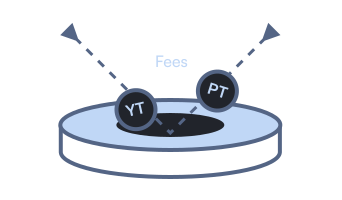
LP positions provide liquidity to the PT/SY AMM. You earn a share of trading fees from volume, while carrying price and inventory risk on the pool.
- Exposure
- PT/SY pool
- Earns
- Trading fees
- Risk
- Impermanent loss
What is an LP position?
Providing liquidity pairs SY and PT in the on-chain AMM so other users can swap between fixed and floating yield. In return, LPs collect a share of every swap fee. Some markets also attach point or coin rewards to LP exposure to reward depth.
Economic model
LP returns are a tug-of-war between fees (which always add) and impermanent loss (which grows as the PT price drifts from where you entered). The chart shows LP value versus simply holding: the concave curve is IL, and fee income lifts the whole curve up. Net return is positive wherever fees outweigh IL.
Impermanent loss-0.07%
Fees earned+1.48%
Net vs holding+1.41%
Concentrated near par
Because PT trends predictably toward par, the PT/SY price tends to move within a narrow band. That keeps impermanent loss smaller than in a typical volatile-asset pool - but it is never zero.
Key properties
- LPs earn a share of PT/SY swap fees proportional to their liquidity.
- Impermanent loss grows with how far the PT price moves while you provide.
- Markets can boost LP with a higher points multiplier, e.g. 1.2×.
- Keep YT mode lets you add liquidity from a single asset and keep the new YT.